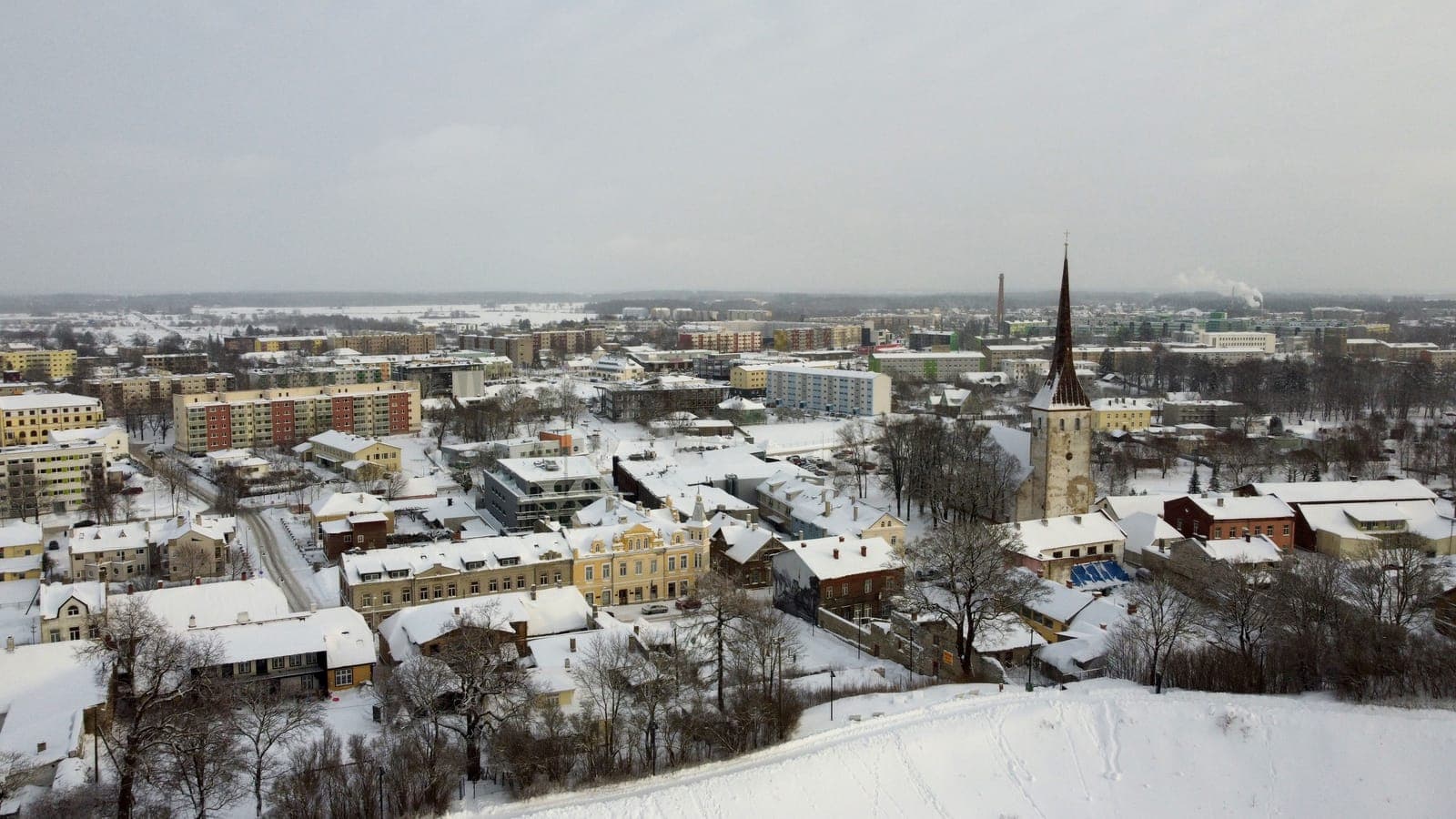

About the city
Rakvere is a town in Lääne-Viru county, in northern Estonia, of just under 15,000 inhabitants, which has made its medieval past and a living culture its most recognisable hallmarks. It is dominated by its castle hill, the Rakvere linnus, a fortress that the Danes began to build in stone in the second quarter of the 13th century over an earlier hillfort and which the Livonian Order enlarged in the 14th century; the town, first mentioned as Wesenberg in 1252, was one of the three royal strongholds of the Danish Duchy of Estonia alongside Tallinn and Narva. At the foot of that history, Rakvere combines the weight of its theatre — one of the country's benchmark performing-arts institutions — with an unmistakable image: the Tarvas, the great bronze sculpture of an aurochs by Tauno Kangro, whose name refers to the medieval place name Tarvanpää, 'aurochs head'.
The town has notable sporting facilities for its size. The Rakvere Spordihall, in service since 2004, offers a main court of 45.4 by 33.15 metres and 10 metres high, more than 1,500 square metres of playing surface and a capacity of 2,747 spectators, and hosts everything from basketball and volleyball to boxing, judo and weightlifting. Its best-known tenant is BC Rakvere Tarvas, a club in the top tier of Estonian basketball, founded in 2006 by Andres Sõber, which won its first Estonian Cup in December 2012. The Aqva spa complex completes the offer with a sports pool of 25 by 15 metres and six lanes, a gym and nine saunas.
Rakvere was distinguished by ACES Europe as European Town of Sport 2022 (locally 'Euroopa spordilinn 2022'), a recognition reserved for municipalities of fewer than 25,000 inhabitants. With it, Rakvere joined the Estonian series of the ACES network opened by Kuressaare in 2020 and Elva in 2021, and which in 2025 would reach the capital, Tallinn, as European Capital of Sport. The title came on the eve of a greater anniversary: in 2026 the town celebrates 800 years of its first mention.
Key facts
Events
Events registered on the platform
No events registered yet